
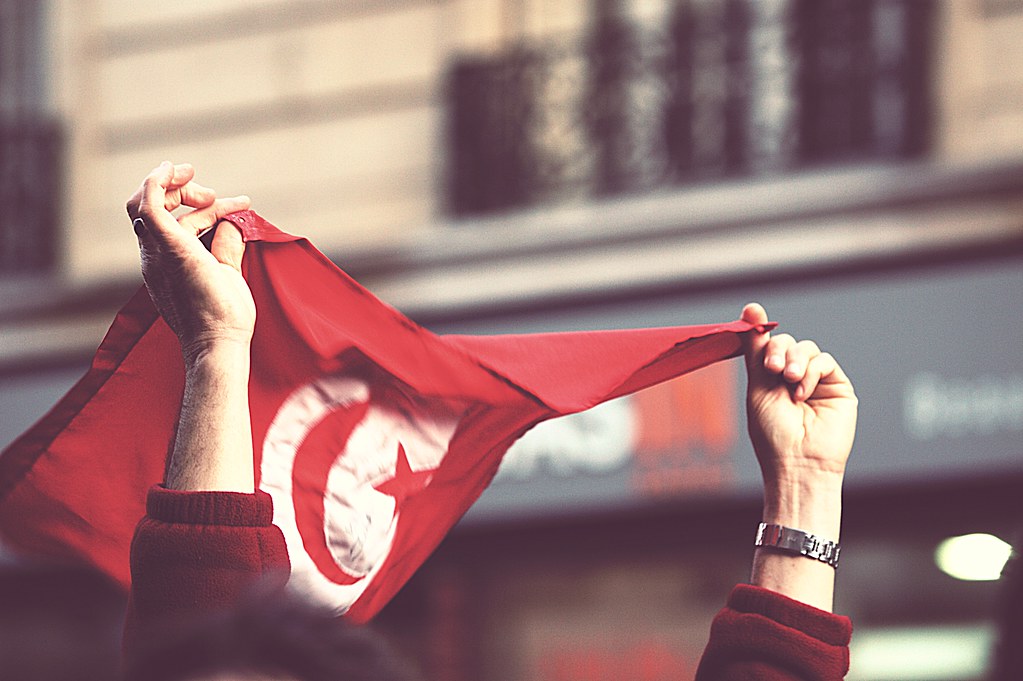
Once a bastion of free speech, it is incontestable that Tunisia is regressing. From the small coastal town of Sidi Bouzid emerged the Arab Spring, the series of political uprisings and rebellions that spread across Arab nations in 2011, including but not limited to Egypt, Syria, Libya, and Yemen. Tunisia was idolised as the archetype of Arab secularism and freedom after the Arab Spring, and people across the Arab world yearned for a similar uprising at home. Fourteen years on, the North African republic appears to have regressed rather than progressed.
My year abroad studying in Downtown Tunis illuminated this situation for me. Watching journalists arrested on live TV for criticism of President Kais Saied’s effectively one-party governance (as with Sonia Dahmani’s case)1, witnessing Saied’s fear-mongering rhetoric about sub-Saharan immigrants destabilising Tunisian identity, confronting a struggling economy, and navigating dirty streets all invite the question: can Tunisia still be considered the Arab world’s role model for freedom and democracy?
Tunisia’s secularism was historically admired, especially by foreign powers and tourists. But it seems that Tunisia can’t decide between extreme secularism or religious fundamentalism. In the wake of the revolution, religious extremism scarred the national consciousness; social wounds deepened by targeted attacks on foreign tourists in a hotel and a museum. Whilst religious views vary, there seems to be an endless tension between some citizens’ colonial-style secularism and others’ strict religious fundamentalism. As a result, moderation in religion seems to be a far-off ideal. Attempts to liquidate the Islamic Ennahda party further suggest Tunisia is perplexed as to what to do with religion.
Equally, Tunisia was praised for its democracy. Now, however, Tunisian democracy is effectively non-existent. In July 2021, President Kais Saied dismissed the government, suspended parliament, revoked parliamentary members’ immunity, and later rolled out a new constitution that concentrated power in the presidency. He has since eradicated meaningful political opposition. By 2024, most parties were marginalised, and only a handful of candidates were allowed to run in elections. Many Tunisian officials have opted not to call Saied out on his actions, but rather, have defended him continuously, labelling any critics of his regime “traitors” 2.
Since then, the president’s rhetoric has become inflammatory and divisive. He has accused sub-Saharan Africans of being part of a plot to alter Tunisia’s demographic makeup, suggesting that their presence threatens Arab identity and aiming to make the country “purely African” 3. As a result, authorities have dismantled migrant camps, housing roughly 7,000 people according to Reuters, and begun forced deportations, drawing sharp criticism from human rights groups and the African Union4.
The situation for sub-Saharan migrants in Tunis is dire. It’s not uncommon to find ten or more individuals cramped into a single apartment, living in overcrowded, dangerous conditions. Many migrants are stranded in olive groves by the coast, subjected to violence, despair, frequent police raids, forced relocations, and complete uncertainty5.
Economically, the country continues to struggle. Growth remains fragile, hovering around 1–2% in 2024–2025. The World Bank projects growth of about 1.9% for 2025, with inflation easing to around 5–6%, although structural challenges persist6. The African Development Bank offers a similar outlook, 1.9% growth in 2025, rising to 2.3% in 2026, with inflation declining modestly and budget deficits slowly narrowing7. Yet systemic issues linger. High public debt, heavy reliance on domestic borrowing, and resource shortages continue to pose risks.
All these realities – the erosion of democracy, xenophobic and exclusionary rhetoric, economic stagnation, and humanitarian crises – prompt a difficult question: Does Tunisia need another Arab Spring?
It is vital that we do not turn a blind eye to leaders who capitalise on conspiracy theories and the “threat” of migrants in order to distract from dire economic conditions and decaying social justice. Perhaps what Tunisia truly needs isn’t necessarily another uprising like the Arab Spring, but rather intense reform, including protection of freedoms, social justice, decentralisation of power and structural economic reform, to reclaim the ideals the country once symbolised.
- BBC News (2024) Tunisia detains lawyer Sonia Dahmani live on TV. BBC News, 14 May. Available at: https://www.bbc.co.uk/news/articles/c4n1jwel080o (Accessed: 3 September 2025).
Human Rights Watch (2025) All conspirators: How Tunisia uses arbitrary detention to crush dissent. Human Rights Watch, 16 April. Available at: https://www.hrw.org/report/2025/04/16/all-conspirators-how-tunisia-uses-arbitrary-detention-crush-dissent (Accessed: 3 September 2025). ↩︎ - Reuters (2024) Tunisia detains prominent activist over migrants’ rights. Reuters, 7 May. Available at: https://www.reuters.com/world/africa/tunisia-detains-prominent-activist-migrants-rights-2024-05-07 (Accessed: 3 September 2025).
Wikipedia (2025) Chaima Issa. Available at: https://en.wikipedia.org/wiki/Chaima_Issa (Accessed: 3 September 2025). ↩︎ - The Guardian (2023) Tunisia’s president calls for halt to sub-Saharan immigration amid crackdown on opposition. The Guardian, 23 February. Available at: https://www.theguardian.com/global-development/2023/feb/23/tunisia-president-kais-saied-calls-for-halt-to-sub-saharan-immigration-amid-crackdown-on-opposition (Accessed: 3 September 2025).
Middle East Eye (2023) Tunisia: President Saied sparks outrage over racist remarks on sub-Saharan migrants. Middle East Eye, 24 February. Available at: https://www.middleeasteye.net/news/tunisia-saied-sub-saharan-immigration-racist-outburst (Accessed: 3 September 2025). ↩︎ - Reuters (2025) Tunisia dismantles sub-Saharan migrant camps, forcibly deports some. Reuters, 5 April. Available at: https://www.reuters.com/world/africa/tunisia-dismantles-sub-saharan-migrant-camps-forcibly-deports-some-2025-04-05 (Accessed: 3 September 2025). ↩︎
- Associated Press (2023) Tunisia abandons migrants in desert as EU seeks to curb crossings. AP News, 12 July. Available at: https://apnews.com/article/e6162d4221062bf09dd13de690da9f91 (Accessed: 3 September 2025). ↩︎
- World Bank (2025) Tunisia Economic Outlook – Spring 2025. World Bank. Available at: https://www.worldbank.org/en/country/tunisia/overview (Accessed: 3 September 2025). ↩︎
- African Development Bank (2025) North Africa Economic Outlook 2025: Tunisia. AfDB. Available at: https://www.afdb.org/en/countries/north-africa/tunisia (Accessed: 3 September 2025). ↩︎



 The Oxford Arabist
Leave a comment