

Spring, 1951. A young boy called Edward was expelled from Victoria College, a prestigious English boarding school in Alexandria, for troublemaking. Whatever commotion led to his expulsion, it could not have been as significant as the furore caused by this boy some three decades later.
Few could have predicted that this privileged boy would go on to form the bedrock of the seismic overhaul of an established field of the Western academy. The arguments that young Edward would go on to make have contributed in no small part to the restructuring and renaming of university faculties and government departments across the Anglophone world and beyond.
The Palestinian-American literary critic, Edward Said, continues to command significant influence over many of those interested in the modern study of the “Middle East”, once upon a time considered under the discipline of Oriental Studies. His book, Orientalism (1978), remains gospel to many postcolonialists, especially those who study the lands stretching from the Mediterranean to the Persian Gulf.
However much critics or supporters try to simplify the work into base arguments, the text itself seems to defy clear categorisation.1 Despite its seismic influence, Orientalism remains problematic, falling into many of the same traps it claims to decry.
A Bridge Too Far: Hegemony and Discourse
The most conceptual part of Said’s Orientalism is also one of its most widely criticised aspects: the struggle to reconcile the two ideas of ‘Western hegemony (of which the sytem [sic] of Orientalism was a part)’2 and ‘Orientalism … as a mode of discourse with supporting institutions.’3 Through his extensive interaction with the writings of Michel Foucault (1926–84) and Antonio Gramsci (1891–1937), Said’s Orientalism brings into conversation their two very different, perhaps even contradictory, theories of discourse and hegemony.
Said holds that his ‘whole point is to say that we can better understand the persistence and the durability of saturating hegemonic systems like culture when we realize that their internal constraints upon writers and thinkers were productive.’4 Yet, he also argues that ‘texts can create not only knowledge but also the very reality they appear to describe. In time such knowledge and reality produce a tradition, or what Michel Foucault calls a discourse.’5
Even more significant than such analysis on Orientalism is the implicit conceptual paradox. Said argues that Orientalists are the malevolent agents of a ‘powerful discursive system maintaining hegemony’6 and yet deterministically constrained by a discourse that blames a system of inequality on texts, not authors.
Said never overcomes this conceptual tension, but arguably gets closest to a synthesis in his acceptance of the contradiction that the idea of portraying productive hegemonic systems was present in ‘Gramsci, certainly, and Foucault and Raymond Williams in their very different ways.’7 The core argument of Said only seems to resolve itself by accepting divergence and multiplicity, a resolution that seems at odds with the theory of a defined Orientalism he seems to champion.
Regardless of the conflicts between Said’s sources on cultural theory, Said apologists can uphold that any conflict is evidence of an inherent distortion contained within a monolithic Orientalism, and polemicists can use any contradiction to undermine the scholarly integrity of Orientalism, as is the case of Robert Irwin.8 While the contradiction may not be quite as great as in Irwin’s description of Said’s ‘incompatible … dot-and-pick approach,’9 the question over whether Said’s primary criticisms are levied against Orientalists or the discourse of Orientalism itself remains ambiguous.
Tidrick’s Resolution: Heart Beguiling Araby
Far too many have overlooked the framework for an English Orientalism posited by the psychologist Kathryn Tidrick in Heart Beguiling Araby (1981), a text arguably far more cohesive than Orientalism. Tidrick offers an alternative examination of the relationship between Orientalism and Empire, drawing a distinction between the particulars of Said’s far-reaching though conceptually contradictory arguments in Orientalism, and the idea of Orientalism itself as a multifaceted process of attempted cultural or civilisational distinction.
Heart Beguiling Araby benefits from a historical focus on individual Orientalists and an awareness in its prologue that the book does ‘not attempt to argue, as Edward Said does …, that writers on the Middle East are primarily to be understood as prisoners of an institutionalized system of discourse which makes it impossible for them to regard Orientals as human beings like themselves. Their faults were legion, but more various and more interesting.’10
By engaging in a more personal process of psychohistory, Tidrick’s humanising discussion on the relationship between Orientalism and empire constitutes authentic analysis, rather than empty theory. The result is a dynamic argument that better distinguishes between individuals and their often conflicting orientalisms.11Such an argument is quite different from Said’s incendiary generalisation that it is ‘correct that every European, in what he could say about the Orient, was consequently a racist, an imperialist, and almost totally ethnocentric.’12
Tidrick’s narrative permits a nuance of internal diversity and even recognition of commonality––especially between English Orientalists and Arabs––that is absent from Orientalism. Tidrick makes no attempt to systematically document interactions between Orientalists and perceived “Orientals”, as Said ambitiously does, but instead focuses on the study of English Orientalists or travellers and Arabs, especially the perceived ‘true’ Arabs: the Bedouin.13
The Arabs and the “Others”
While his extensive attention on the Middle East is commendable, Said’s uneven focus on the Arabs as universal representatives of perceived “Orientals”—and, apparently to Said, as the main representatives of Islam—reads as both overly personal and unrealistic.14 We find frequent collocation in Orientalism of Islam and Arabs or Arabs and Muslims, often implying synonymity or, at times, with Muslim as a subset of Arab. Said does not seem aware of processes comparable to the Orientalism he describes having taken place in a long tradition of Arabic writing on “Eastern” peoples dating back at least as far as the eleventh century CE, especially in India.15
On at least two occasions, Said explicitly conflates the category of Arab with the religious designation of Muslim in the phrase ‘Muslims (or Arabs).’16 While he frequently uses the term ‘Arab’ independently from ‘Muslim’ or ‘Islam’—a distinction clear in Said’s own Arab Christian background—he uses rarely the term ‘Muslim’ independently from ‘Arab’ and seldom to describe non-Arabs. An important non-Orientalist criticism of Said can be made against his own othering through the implication that Muslim identity is either a subset of an Arab identity—which he is surely too clever to suggest—or, more likely, that being a Muslim is in some way attached to the fate of the Arabs, still a dangerously naïve generalisation.
In imposing such a hierarchy, Said seems to, consciously or otherwise, promote the idea satirically posited by Shabbir Akhtar of the perception of ‘Arabs as the white men of the East,’17 the best example by which to achieve salvation of all “Orientals”. Even Said engages in a process of placing one culture or civilisation above others. Thus is Said’s Orientalism, despite its arguments and appearances, not so separate from the Orientalism that it is ostensibly trying to deconstruct.
Said’s arguments in Orientalism even go so far at times as to amount to an Arab exceptionalism, distinguishing the Arabs from “Orientals”. While attempting to disparage anti-Orientalist writings, Irwin notes Said’s continued acceptance of Gustave Le Bon (1841-1931) and his La Civilisation des Arabes (1884) among anti-Orientalists. Irwin writes that, although ‘Le Bon was a racist, he seemed to be a pro-Arab racist,’ which has justified his more positive treatment among anti-Orientalists.18 Despite Irwin’s bombastic tone, his point regarding Le Bon seems sound, since Said only categorises him under ‘latent Orientalism.’19
By strange contrast, Said places the influential English convert to Islam, Muhammad Marmaduke Pickthall (1875-1936), as a proponent in a field of ‘exotic fiction of minor writers.’20 Said neither recognises Pickthall’s conversion to Islam nor refers to him by his chosen Muslim name, Muhammad.
By playing such an uneven hand, Said leaves room for more zealous Orientalists, such as Bernard Lewis (arguably Said’s most personal target in writing Orientalism),21 to undermine the entire work. Lewis is, rather arrogantly, justified in writing that ‘there have been very few attempts by the anti-Orientalists in the West to produce their own contributions to Arab history. When they have tried, the results have not been impressive.’22 While harsh, Lewis does highlight how much anti-Orientalist literature has still relied upon Orientalist writing.
Said’s distinction between Arabs and other “Orientals” bears particular similarity to the view among Victorian Orientalists that ‘the Arabs, unlike other Orientals, were gentlemen,’ leading Tidrick to argue that ‘literate Englishmen began to feel a sense of affinity with them.’23 Regardless of the precise accuracy of this claim, the commonality with Said’s argument is strangely clear, especially in his sympathetic description of Richard Burton, noted by Said as possessing a ‘sympathetic self-association with the Arabs.’24
We similarly find a peculiar inversion of roles between Lewis and Said over the description of ‘various Indian dialects,’ which Said does not give the status of languages, let alone name.25 This allows Lewis to quip that ‘the assumption that what Indians speak and write are not languages but dialects would be worthy of an early-nineteenth-century district commissioner.’26
Nonetheless, in Said we still broadly find an honest attempt, if unfortunate elevated prioritisation of Arab perspectives, to overcome a set of perceived injustices, while with Lewis do we find a far more guileful attempt to preserve the institutions of which he was very much a part.
Saidian Orientalism
Orientalism—or perhaps more accurately, orientalisms—remains an ongoing process that certainly did not cease with Orientalism and perhaps survived in no small part thanks to Said’s popular work and the contemporary transformation it brought about to the discipline. Both Oriental Studies––or, if less offensive, Asian and Middle Eastern Studies––and Orientalism are by no means monolithic.
Irrespective of the views of individual authors on their own works, anti-Orientalist writings largely operate within a broader process of Orientalism. Not only do such texts interact with older Orientalist literature, anti-Orientalist writers at times rely upon the indispensable work conducted by Orientalist scholars in forming their own arguments. On occasion, they even share similar conceptual frameworks or traces of a hierarchical worldview.
While noticeable, such a contradiction is not as significant as the structural issue of how Orientalism is conceptualised as both discourse and hegemony. In his attempted synthesis of Foucault and Gramsci, Said’s argument does seem perhaps too thinly stretched for one book.
The representation of such wide-ranging ideas in one moderate-length book is arguably Orientalism’s greatest strength. In its compact format, Orientalism offers an opportunity for many previously unfamiliar with the field of Oriental Studies to interact with it. While Lewis and Irwin have plenty to criticise in Said’s arguments, there nonetheless seems to be an acknowledged consensus that a book of theory in Oriental Studies was long overdue.
Although the arguments of Orientalism in their day were timely and theoretically far reaching, it is a shame that, as the first major work on this topic, it had to be written from an academic from outside the field. While Tidrick, also an outsider, offers a more cohesive argument than Said, her moderate perspective has sadly failed to achieve the same revolutionary popularity.
Following Said’s tragic and all-too-early passing in 2003, Orientalism continues to capture the imagination of those who study Asia and Africa. The rebuttals of Irwin and Lewis testify to how, although Orientalism has contributed to the formation of popular and contemporary orientalisms, Said failed to change the hearts and minds of an Orientalist generation.
The determined little troublemaker in 1951 never won over his schoolmasters either. But what did that matter, if he won the respect of generations of students all too willing to overlook their saviour’s human flaws?
Adam Rashid-Thomas
St John’s College, Oxford
In memory of Shabbir Akhtar (1960-2023)
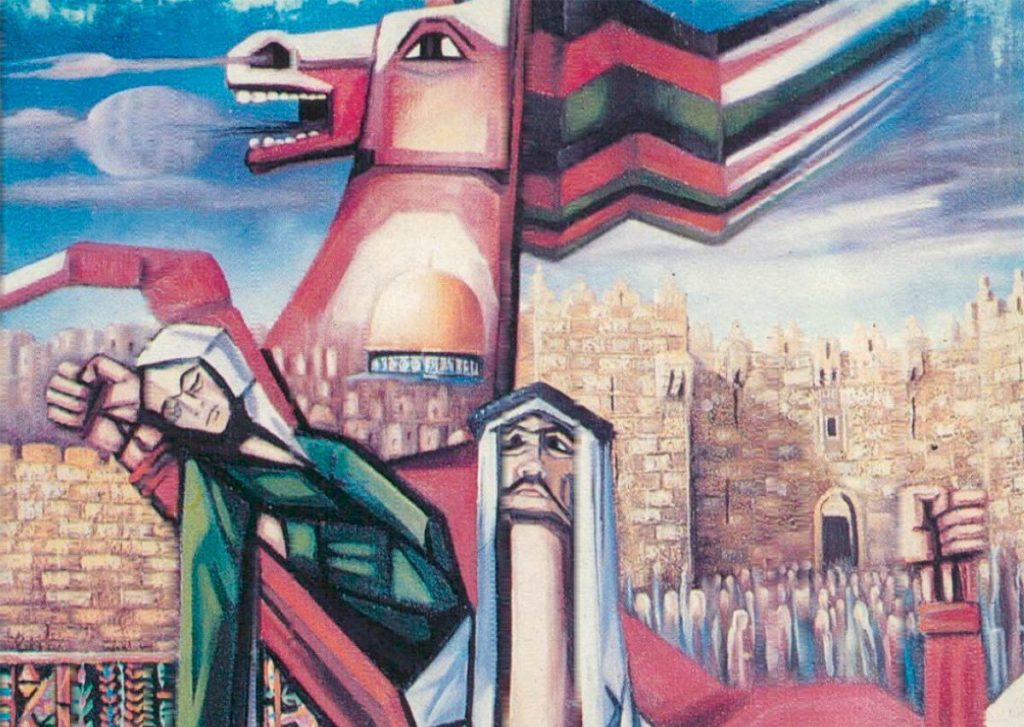
Cover image: Farhad Ahrarnia, Modern Stage arrangement no. 3, mixed media and embroidery on canvas, 80 x 120 cm, 2013. See also Sarah Raza, Punk Orientalism: The Art of Rebellion. London: Black Dog Press, 2022.
References
Ahmed, Shahab. What is Islam?: The Importance of Being Islamic. Princeton: Princeton University Press, 2016.
Akhtar, Shabbir. The Quran and the Secular Mind: A philosophy of Islam. Abingdon: Routledge, 2008.
Elmarsafy, Ziad, and Anna Bernard. “Orientalism: Legacies of a Performance.” In Debating Orientalism, edited by Ziad Elmarsafy, Anna Bernard and David Attwell. Basingstoke: Palgrave Macmillan, 2013.
Irwin, Robert. For Lust of Knowing: The Orientalists and their Enemies. London: Penguin, 2007.
Kozah, Mario. The Birth of Indology as an Islamic Science: Al-Bīrūnī’s Treatise on Yoga Psychology. Leiden: Brill, 2016.
Lewis, Bernard. “The Question of Orientalism.” The New York Review of Books, 24 June 1982.
Said, Edward W. Orientalism. 6th ed. London: Penguin Random House, 2019.
Tidrick, Kathryn. Heart Beguiling Araby: The English Romance with Arabia. 2nd ed. London: I.B. Tauris & Co., 1989.
- See Ziad Elmarsafy and Anna Bernard, “Orientalism: Legacies of a Performance,” in Debating Orientalism, ed. Ziad Elmarsafy et al.(Basingstoke: Palgrave Macmillan, 2013), 2. ↩︎
- Edward W. Said, Orientalism, 6th ed. (London: Penguin Random House, 2019), 328. ↩︎
- Ibid., 2. ↩︎
- Ibid., 14. ↩︎
- Ibid., 94. ↩︎
- Ibid., 339. ↩︎
- Ibid., 14. ↩︎
- Robert Irwin, For Lust of Knowing: The Orientalists and Their Enemies (Penguin, 2007), 289–290. ↩︎
- Irwin, For Lust of Knowing, 289. ↩︎
- Kathryn Tidrick, Heart Beguiling Araby: The English Romance with Arabia, 2nd ed. (I.B. Tauris & Co., 1989), 2. ↩︎
- I note the influence in formulating a description of orientalisms, as opposed to a single Orientalism, from the work of Shahab Ahmed in defining an argument “islams-not-Islam”. Note that this does not imply agreement with Ahmed’s argument in the context of defining Islam. See Shahab Ahmed, What is Islam?: The Importance of Being Islamic (Princeton University Press, 2016), 131–137. ↩︎
- Said, Orientalism, 204. ↩︎
- Tidrick, Heart Beguiling Araby, 30. ↩︎
- See Said, Orientalism, xii, xv, xvi, 17, 26, 27, 59, 60, 75, 105, 106, 108, 151, 155, 201, 236, 237, 262, 278, 284, 285, 287, 293, 300, 302, 303, 316, 319, 321, 322, 329, 331, 335, 344, 347. ↩︎
- See, for example, Mario Kozah, The Birth of Indology as an Islamic Science: Al-Bīrūnī’s Treatise on Yoga
Psychology (Brill, 2016). ↩︎ - Said, Orientalism, 287, 316. ↩︎
- Shabbir Akhtar, The Quran and the Secular Mind: A Philosophy of Islam (Routledge, 2008), 163. ↩︎
- Irwin, For Lust of Knowing, 312. ↩︎
- Said, Orientalism, 207. ↩︎
- Ibid, 252. ↩︎
- Ibid, 342. ↩︎
- Bernard Lewis, “The Question of Orientalism,” The New York Review of Books, (24 June 1982), 9. ↩︎
- Tidrick, Heart Beguiling Araby, 31. ↩︎
- Said, Orientalism, 195. ↩︎
- Ibid, 322. ↩︎
- Lewis, “The Question of Orientalism,” 13–14. ↩︎


 The Oxford Arabist
Leave a comment