
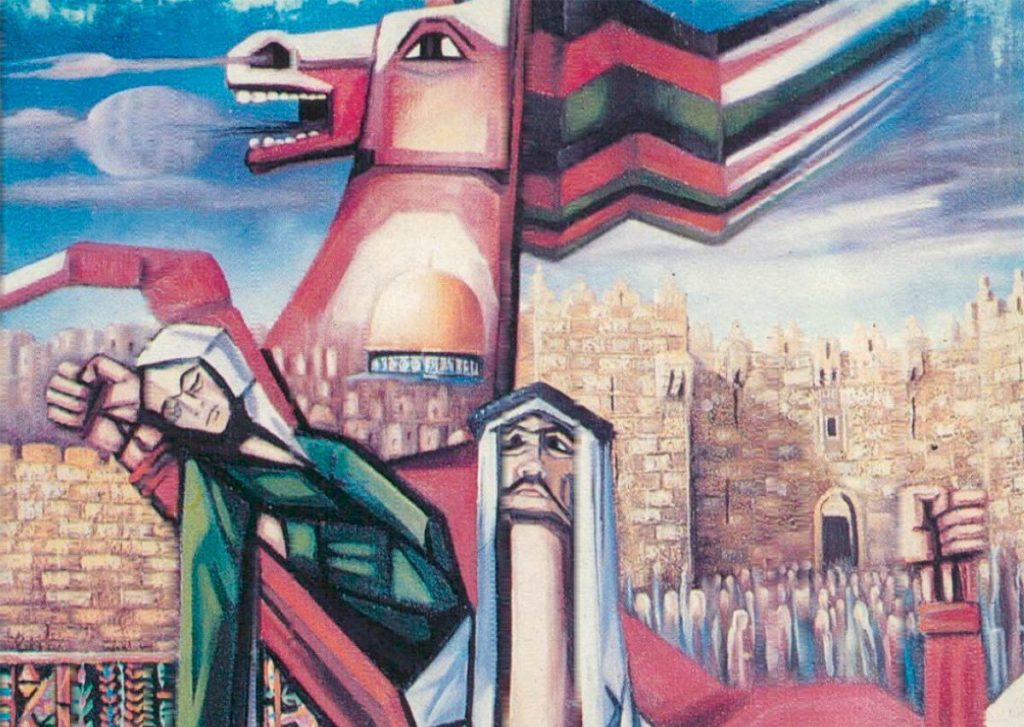
‘What matters are the needs which art answers.’ – John Berger
Fathi Ghaben (1947-2024) was a Palestinian painter whose work played a dual role: at once witness to the struggles of his life in Gaza and a rallying call to oppose this oppression. Both are acts of resistance. So too is the survival of his art, through Israeli bombardments which serve to highlight its continued relevance. Today much of his major work survives thanks to the recovery efforts of his family, including his son Khaled who I spoke to. This defiance in the face of destruction is a fitting legacy for Ghaben and testament to the way in which his art continues to answer the needs of the Palestinian people.
Born in Hirbiya in the Gaza Strip just before the Nakba, Ghaben’s family were forced to flee to Jabaliya camp when the village was depopulated. This camp was where he spent most of his life, until he moved to Nasser in 2015. A key and acclaimed figure of the Palestinian art scene, Ghaben exhibited internationally, was an advisor to the Palestinian Ministry of Culture, founded arts organisations in his native Gaza including the Fathi Ghaben Center of Arts, and received various awards. He died in February 2024 after being denied permission to leave Gaza to seek medical treatment.
In this context, the very creation of art was itself resistance, an assertion of humanity. Ghaben left school to support his family, selling newspapers and working in a citrus orchard. He began painting around this time, self-taught. In a 2008 interview in The Palestinian Chronicle, he spoke of the financial pressures – a need to ‘put food on the table’ – that led him to begin by producing ‘commercial art’, though, in the same breath, he rejects this very notion. A distinction that he does draw is between this economically-motivated art and his later ‘patriotic’ works. Yet the troubles he spoke of having at the time of this interview – of not being able to afford painting materials, of the need for the border crossing to open to allow his work to be exhibited internationally – reveal just how inescapable the external situation was, and how inextricably tied Ghaben’s career was to the political context it was forged in. There is a danger, as Mahmoud Darwish warned, of reducing Palestinian literary (or here, artistic) output to political readings, denying them full critical attention. However, a de-contextualisation of Ghaben’s work is impossible, swinging as it does – as he describes it – between the commercial directions necessitated by the economic situation and art which is expressly political in aim. Viewing his work through such a lens is – I hope – not so much a reduction than a recognition of the ineluctability of Israeli occupation and oppression. His son Khaled, after all, described him fittingly as ‘an artist of the Palestinian revolution’.
I take as a basis that the very production of art is, in this context, a resistance act, yet Ghaben’s paintings go further than the fact of their being.
So just as artistic creation is an expression of humanity, depictions of Palestinian life and culture serve as an assertion of their defiant existence. Ghaben paints the Palestinian people in camp and village, at weddings or work; testifies to the presence of Palestinian culture through depictions of dabke and traditional dress including tatreez (embroidery). His preference for painting figures in media res gives his work a movement, liveliness which is too an act of rebellion; this is a living, working, resisting culture. Yet one of the simplest and most provocative ways in which he stated this national presence was in his depictions of the Palestinian flag, being the first to do so in painting. Such depiction was criminalised in 1967, and the ban was expanded in 1980 to prohibit artworks that included the four colours together. Ghaben painted Palestinian culture in all its aspects, and alongside it included this radical statement of national existence.
Further still, the Palestinian flag was not simply there as a static affirmation of nationhood, but like the moving figures of Ghaben’s paintings, it takes on an acting, resisting life. It becomes a horse, for example, in Freedom Painting, an Arabian horse – a classic symbol of strength but also Arab identity – breaking free from its chains. This is a recurrent image in his work, appearing too in his famous Identity, where the horse’s mane becomes the Palestinian flag, and its neck fades out to reveal and frame the golden Dome of the Rock of the Al-Aqsa Mosque complex in the skyline.
Ghaben was arrested multiple times for his art, most notably in 1984 when he was sentenced to six months in prison along with a fine and the confiscation of seven of his paintings. Charged with inciting violence, this response proves the political power of his artistic depictions of Palestinian life insofar as they evidently threatened the occupying forces. Ghaben’s resistance, however, goes a step further once again, from documentary depiction to prediction. In a 2015 interview with Al-Monitor, 1 Ghaben singles out Identity as having made him a target. In its depiction of protest at the Damascus Gate in Jerusalem, symbolic as a place of resistance, he maintains that it anticipated the First Intifada of 1987 – 1993.
The rallying nature of this painting was recognised, and it was printed onto coloured posters and distributed throughout Gaza and the West Bank. This undoubtedly played a large role in his arrest (confirmed by an Israeli officer who was interviewed about it),2 yet it is also testament to the popular power of art. Just as, in the aforementioned interview, Ghaben rejects the elitist disparagement of commercial art, these reproductions of his painting were not “copies” of secondary value, but where the very power of the art lies. The widespread resonance evident in this act of distribution is perhaps a greater testament to its value than any commendation from art critics or establishment. Though international exhibition is important, both for material reasons (for him and now his family) as well as to recognise the artwork that continues to come from the region, this traditional route must not be attributed greater importance than the informal means of distribution that took place in this case, which allowed his work to reach a wide-ranging domestic audience; the audience which were able to recognise their own reality and potential through these posters. As Berger says in the quote I open with, the importance of art lies in its answering of needs. The revolutionary value of Ghaben’s work is insofar as it speaks to the Palestinian people, such as in affirmations of national culture or the incendiary hope-giving of Identity. The protests in Tel Aviv, East Jerusalem, and Jabaliya camp in response to his arrest only confirm this popular resonance that his work had.
Yet the needs to which Ghaben’s work answers have only become more pressing in recent years as Israeli oppression and genocide intensifies. I spoke to Khaled about the bombing of the family home which destroyed most of Ghaben’s artworks. In a six-hour-long search, he describes how ‘we were able to retrieve approximately 8 artworks, but some remained torn under the rubble of the house. Among these torn artworks was the famous Ain Jalut painting’. One that was recovered was Identity, the painting which had proven to be such a rallying cry four decades earlier. The symbolism of this painting surviving the bombardments and being salvaged from the rubble, the defiant stance of the central figure as he emerges, need not be overstated. Recovering art in such conditions – prioritising the survival of these paintings – is a statement of its importance. Ghaben’s art responded to the needs of the Palestinian people, providing representation, defiance, and hope. Its survival despite the odds represents a continued parallel between people and artistic representation.
Now, Ghaben’s family are in need of support, notably to evacuate his injured son so he is able to receive the urgent medical treatment that he needs. Their GoFundMe can be accessed by clicking here.
Bibliography:
Cover Image: Fathi Ghaben. (1980) Identity
John Berger. (1969) Art and Revolution: Ernst Neizvestny and the Role of the Artist.
Alserkal Avenue, https://alserkal.online/words/fathi-ghabin-a-self-portrait-of-the-working-class#_ftn1
Artforum, https://www.artforum.com/news/fathi-ghaben-dead-at-77-550410/
Hyperallergic, https://hyperallergic.com/palestinian-artist-fathi-ghaben-dies-after-israel-blocks-travel-for-treatment/
The Palestine Chronicle, https://www.palestinechronicle.com/fathi-ghaben-great-palestinian-painter/
- Quoted in Hyperallergic. ↩︎
- He is reported as saying, ‘[p]aintings of Fathi Ghabin were distributed in tens of thousands [of] copies throughout the Gaza Strip and the West Bank, and they were used as propagandist means to call the people to get out to the streets and throw stones and demonstrate and break the law. Did you, by any chance, see [any] of those paintings?’; Alserkal Avenue. ↩︎


 The Oxford Arabist
Leave a comment