
Disney’s Aladdin has remained a beloved family favourite for generations, with its humour, music, and spectacle often overshadowing the stereotypes embedded within its storytelling. In both the original animated film (1992) and the live-action remake (2019), Disney replaces the themes of One Thousand and One Nights with familiar Western Orientalist tropes. I explore how the films’ language, music, and visual imagery construct an exoticised and distorted vision of “what an Arab looks and acts like”.
Arab culture as primitive and violent
The original opening song lyrics for Arabian Nights were “Oh I come from a land, from a faraway place/ Where the caravan camels roam/ Where they cut off your ear If they don’t like your face/ It’s barbaric, but hey, it’s home”
After campaigns from the American-Arab Anti-Discrimination Committee (ADC), Disney retracted the lyric about cutting off ears for the home video release, replacing it with “Where it’s flat and immense/ And the heat is intense”, yet insisted on keeping the word “Barbaric” in a children’s film intending to depict the Arab world. In 2019, lyrics were replaced with “it’s chaotic, but hey, it’s home”, yet this is hardly an improvement, “chaotic” remains a negative adjective connoting instability and lack of order, which are also other common stereotypes associated with non-western regions.
The cartoon is rife with violent imagery and language that builds on western fantasies of the “savage” East, and it further reinforces the “barbaric” stereotype by associating cruel punishments with Middle Eastern culture.
Guards and merchants are quick to resort to violence by hitting Aladdin with batons before throwing him into the ocean, and merchants attempt to cut off Jasmine’s hand for taking an apple to feed a hungry child. Another merchant tells Jaffar that he had to “slit a few throats”, Jaffar claims that Aladdin has been “beheaded” and that Jasmine may have himself and his pet parrot executed. At another point, the Genie pretends to behead himself as a joke. In the 2019 version, these same scenes were recycled. Jaffar pushes a servant down a well, and orders (stereotypically Arab looking and bearded) guards with swords to batter Aladdin before throwing him into the ocean. While “beheadings” are not explicitly mentioned, “burying bodies” to reach powerful ranks are.
In the original tale, there were no such themes of beheading, throat-slittings, mutilations like cutting off hands and ears, or concealing dead bodies. Disney fabricated these, as well as Aladdin’s character.
Disney’s Aladdin is an orphan who steals to survive, whereas in the original One Thousand and One Nights, he is neither an orphan nor a thief. Instead, he comes from a stable household with his widowed mother playing a vital role as a cotton spinner who financially supports her family. While she is the perfect example of an independent and financially literate Arab woman, Disney preferred to kill her character off.
Orphaning and criminalising Aladdin teaches children that the destitute Arab resorts to crime, and that Arab societies lack either the resources or the will to care for their underprivileged. By turning Aladdin into a street thief and depicting Bazaars crowded with beggars and hungry children (like the one Jasmine tries to feed), Disney sought to not only link Arab identity to criminality and desperation, but to also force an image of a poverty-ridden Middle East.
American values were also imposed onto the Middle Eastern folktale, with Aladdin’s character following a “rags to riches” trajectory, symbolic of the American Dream.
Racial bias in character depictions and names
Regardless of where one grew up, the image of the “dangerous and violent Arab” is recognised by all and Disney relied on this to create its villains.
Secondary characters are portrayed as despotic, ruthless and thieving. They, along with Jaffar, the merchant men, and palace guards, who show traits of aggression and violence, are all illustrated with disproportionate and exaggerated stereotypically Middle Eastern, and, facial features: darker complexions, large hooked noses, long black beards, and large bloodshot eyes. Children are bound to find these images unusual if not disturbing and threatening, and at its core, reinforces the visual trope of the “evil Arab”. Jaffar in particular, is called a “dark sinister man”, and throughout both versions, Disney portrays the villains as Arab and dark.
In his book The TV Arab, Jack G. Shaheen writes that “the present-day Arab stereotype parallels the image of Jews in pre-Nazi Germany, where Jews were painted as dark, shifty-eyed, venal and threateningly different people”.
In contrast, the “good” characters, Jasmine and Aladdin, who present traits of kindness, humility and compassion, are westernised. Aladdin is clean-shaven, and both are illustrated with proportional anglicised features like smaller noses and lighter complexions. This teaches children to measure virtue by how closely a person is in proximity to westerners.
Regiolectal differences also exist between these characters; Jaffar speaks with a thick supposedly “Arab” accent. Jasmine and Aladdin however, despite being citizens of “Agrabah”, are the only characters who somehow speak with standard American accents. For most children, noticing familiarity in others is what causes them to identify people as good, trustworthy and safe. The standard American accent is familiar to western children, while the foreign and inaccurate “Arab” accent comes across as strange and threatening.
In 2019, exaggerated inaccurate Arab, as well as a mix of Persian and South Asian, accents remained for all villainous and secondary characters. Despite the Middle East being home to many different ethnic groups with a range of complexions, extras in the 2019 film also had their skins darkened backstage.
Disney additionally westernised the good protagonists’ names. “Jasmine” is an English translation of the Arabic name “Yasmin” or “Yasmeen”, and the genie abbreviates Aladdin’s name to “Al”, after which he is referred to as “Prince Ali”. Conversely, villains like Jaffar keep their Arab names. I recognise the name Jaffar as the names of Jafar ibn Abi Talib, and Imam Jafar al-Sadiq, both prominent figures in Islamic history, yet because of Disney, for my peers and other children globally, the name has been instead unduly associated with this villain. Children grew up on cartoons like Aladdin, and learnt from them. Therefore, what a villain is named, and who that villain is associated with, teaches them who to fear, and who not to trust.
I also cannot help but view the westernising and abbreviating of characters’ names in the larger context of name bias in Western societies. Multiple BBC studies have shown significant name bias in hiring, with one study finding that applicants with Muslim-sounding names are three times less likely to receive interviews than their counterparts with British-sounding names, despite having identical qualifications.
Disney eliminated the “Arab” identities of the good characters to create likeable and “friendly” personas for western children to relate to. In doing so, all those who illustrated and voiced over these characters and misused their artistic talents in this way, sent a clear message to Middle Eastern children watching, that to be good, accepted, and civilised, they must mimic the European, in appearance, accent, name, and so on; that if they do possess the good qualities demonstrated through Jasmine and Aladdin, it is them mimicking the European or American way of life for these moral traits do not naturally belong to people who look and sound like them.
Regardless of whether the children watching have Middle Eastern heritage, these illustrations further encourage them to internalise and justify socially constructed hierarchies of difference and inferiority between people. A great deal of artistic skill, and effort was put into making these grotesque illustrations that disrupt a Middle Eastern child’s self-perception, and can cause them to belittle their own communities, who if like me grew up in the UK, would already be a marginalised community.
As someone who rewatched Aladdin many times as a child, this begs me to ask: why? Why seek to convince Middle Eastern children (especially those who grew up outside the countries they ethnically belong to), to further associate ourselves, our features, and how our possibly immigrant grand and/or great grandparents may speak English, with primitiveness, criminality, poverty, and violence? Does it not suffice to grow up hearing of the 70s and 80s pogroms that our grandparents survived, and witnessing interactions that exhausted our parents? Or must we also be made to watch cartoons humiliating us in front of our peers, and further encouraging our self-rejection?
Portrayal of women
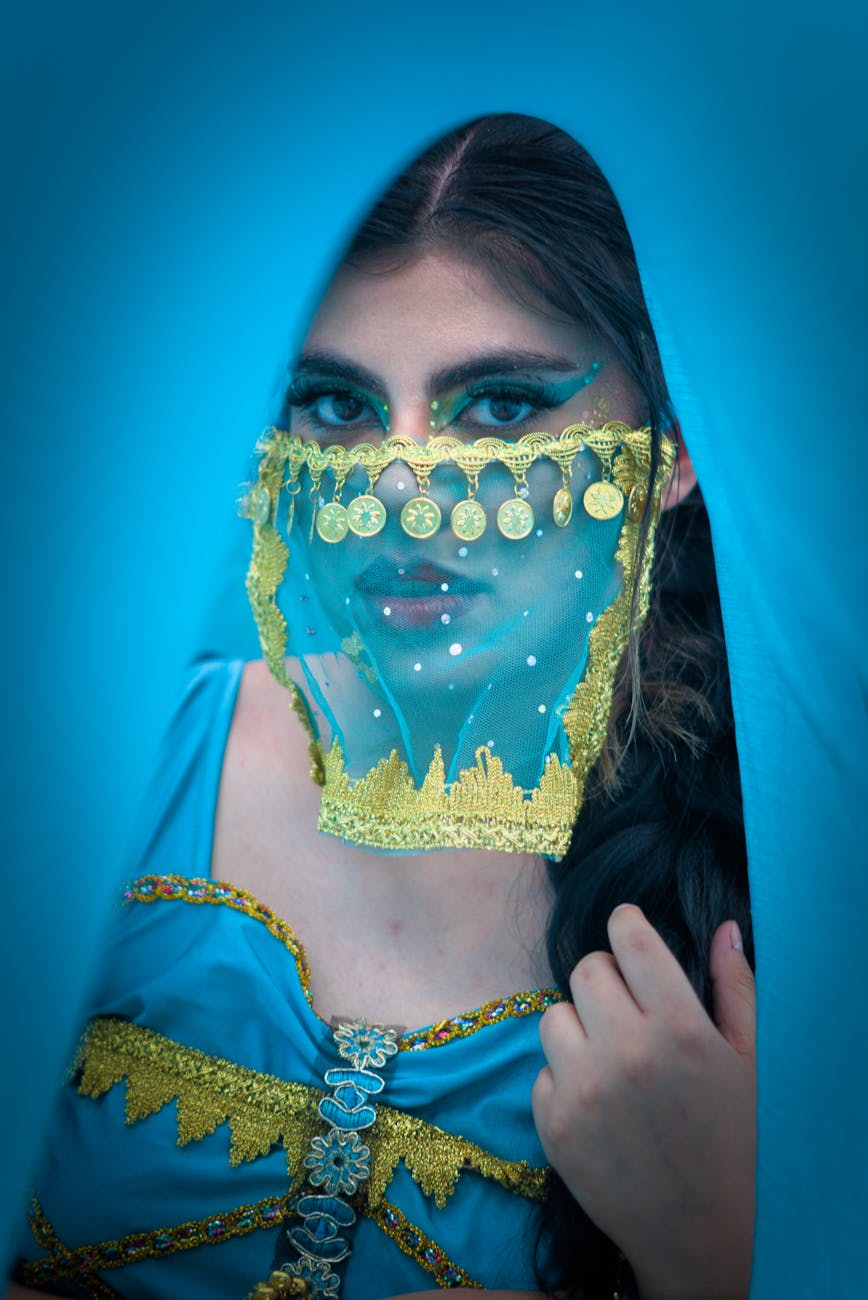
Secondary female characters in both versions are either veiled or in belly dancing attire. In the Prince Ali song, lyrics include “Adjust your veil for Prince Ali”, and similarly in 2019, “Adjust your veil and prepare for Prince Ali”. Simultaneously, both versions repeat scenes of Bellydancers portrayed in a flirtatious manner, who, despite the dance having Egyptian origins, wear Indian bindis and saris.
Their prevalent presence is not only culturally inaccurate, but objectifies ‘Middle Eastern’ women. Jasmine is exoticised and she too wears culturally inaccurate and revealing clothing. In the cartoon, Jaffar calls her a “beautiful desert bloom”, and in the 2019 Prince Ali song, the genie sings “I heard the Princess is hot, where is she?”. Despite both Aladdin versions being promoted as family friendly productions, scenes show Jasmine attempting to seduce Jaffar to distract him, portraying ‘Arab’ women as sensual and ‘Arab’ men as lecherous.
In the cartoon, Jasmine’s father holds patriarchal views, and this is shown to be linked to his supposedly Islamic faith, telling his daughter “Allah forbid you should have any daughters”. He expresses concern over his daughter not yet being married, and suggests that she must marry a man of his choosing because it is “custom”. Jasmine tells him “I hate being forced into this”, refuses multiple proposals, and tells Aladdin, “my father is forcing me to get married”.
The same rhetoric repeats in the 2019 remake where Jasmine’s father tells her “we must find you a husband” because she “can never be a Sultan”. Jaffar reinforces similar patriarchal perspectives, telling Jasmine that it is better for her to follow “traditions” including “to be seen and not heard”, and she later sings “they want to keep me quiet”, referring to the men in her life. The film did not correct, but only strengthened this portrayal of Middle Eastern women lacking autonomy and living behind dictatorial men in their lives. When discussing marriage, Jasmine’s lady-in-waiting encourages her to accept a proposal by saying “you’re just getting married, it’s not like you have to talk to him”, giving the audience the impression that marriages in the Middle East are not built on common interests, and are forced.
Such representations of victimhood affirm Edward Said’s argument in Orientalism, that the “Western male gaze” depicts Oriental women as silent, sensual objects. To accommodate this victimhood persona, Disney replaced the original character of Princess Badroulbadou in the written text, to instead introduce Princess Jasmine as their stereotypical ‘Eastern’ woman, whose freedom, and knowledge about the outside world, is restricted, and is frustrated with her father’s insistences on her getting married. In the original text, unlike Jasmine, Princess Badroulbadou was satisfied with her life and there were no references to marriage.
Merging and erasing the distinction between different non-Western cultures.
Aladdin was originally scheduled for release in 1991 and set in Baghdad. Following the Gulf War, Baghdad became a more recognised place, and the setting was changed to the fictional Agrabah, a distant unfamiliar land. Disney merged Arab, South Asian and North African cultural, architectural, and geographical elements to create a mismatched landscape. In both versions, our distinct cultures and identities are erased, and caricatures of a mix of our cultures are portrayed alongside each other to thrill the western audience who only sees the same “other”.
Arab and Islamic architectural features like domes, minarets and arches exist alongside a palace whose illustration took inspiration from the Taj Mahal in India. Arab and Islamic civilisations have made great artistic and architectural contributions beyond the recognised arches and domes, and such representations dismiss and reduce this diversity. The lack of respect for cultural accuracy and specificity is also evident with the geographical elements completely dismissing the Middle East’s diverse flora and fauna. Agrabah’s climate is hot, with the heat and camels first mentioned in both opening songs, but animals in this desert landscape include jungle animals: elephants, flamingos, parrots, monkeys and an Indian named Tiger.
This was intentional, Disney never intended to create a realistic Agrabah. The setting was not designed to be understood or real, but to instead satisfy a western fascination for the ‘exotic’ and ‘unusual’ East. In 2019, the opening lyrics perpetuated this by introducing a “Mystical land of magic and sand”.
None of this imagery is unique to Aladdin. Films like The Sheikh (1921), Arabian Nights (1974) and Raiders of the Lost Ark (1981) all portray the Arab world as a faraway fantasy land with genies, flying carpets, veiled women in busy bazaars and wealthy men living in palaces with women secluded away in harems. When Jack G. Shaheen analysed 1000 Hollywood films from 1896 and 2001 that include or reference Arabs, he found that only 12 were deemed positive representations. Social affairs correspondent Lucy Ward, argued that “the problem with portrayals in these films was not the fact that they are negative images, but that they are the only images”, and that suggestions that Aladdin was never intended to be realistic are “analogous to saying similar things to the Jewish community in the early 1930s”.
In 2019, Aladdin was played by Egyptian Canadian actor Mena Massoud, and Jasmine was played by Indian British actress Naomi Scott. Such casting again merged Indian and Arab cultures and actors to reinforce the aforementioned stereotypes. Other cast members included Jake Gyllenhaal (who was cast in the lead role of The Prince of Persia: The Sands of Time), and Christian Bale and Joel Edgerton (who were both cast in Exodus: Gods and Kings, as Egyptian characters).
When producer Ridley Scott was questioned on why they were cast in place of Middle Eastern actors, he infamously replied that he “Can’t say that my lead actor is Mohammad so-and-so from such-and-such. I’m just not going to get it financed”. His statement directly affirms the multiple studies reported by the BBC regarding the discrimination against Muslim and Middle Eastern sounding names.
I remember Aladdin most through its nostalgic song, A Whole New World, but the world that I was actually shown as a child, and again as a teenager, was of cheap caricatures, forced marriages, flirtatious women, beheadings and roaming camels that neither honoured, nor couldn’t be farther from, the original One Thousand and One Nights text, which as a result of Disney’s Aladdin, has also been tampered with in recent children’s books and summaries.
The 2019 version did not move away from the cartoon’s Orientalist tropes, but instead reminded audiences of them. Children watching the later version still do not see any distinct Middle Eastern culture, but a fabricated interchangeable “East”, teaching them that all “brown” people are the same “barbaric” “other”. I wish I could say that Aladdin is merely a lazy portrayal that shows just how little effort Western media puts into representing us, however, it is clear that indeed great effort, intention, and artistic skill was put into the making of both Aladdins, but only to amuse a Western audience at the expense of mocking, degrading and vilifying us.
References:
1.Alsultany, Evelyn. “How the New Aladdin Stacks Up Against a Century of Hollywood Stereotyping.” USC Dornsife. May 28, 2019.
2. Beviano, Christina. “Orientalism in Film: Aladdin Over the Last Century.” n.p., n.d.
3. Hassan, Maya. “The Social Inequities in Aladdin and Its Post-Colonial, Orientalist Approach.” Medium, October 10, 2024.
4. Huwaidi, Mohammad. “Aladdin: From Damascus to Disney – A Journey Through Cultures and Misunderstandings.” Medium, June 3, 2025.
5. Ibrahim, Riad. “The Rub on ‘Aladdin.’” Los Angeles Times, January 4, 1993.
6. Ibrahim, Rofida. “Arabs and Muslims in the Eyes of Disney from the Old Aladdin to the New: A MCDA Perspective.” Hamad Bin Khalifa University, 2023.
7. Piantanida, Giorgia. “Representation of Arabs and the Middle East in Western Media.” Al Fusaic, August 2, 2023.
8. Rahaya, Mundi. “‘Aladdin’ from Arabian Nights to Disney: The Change of Discourse and Ideology.” n.p., 2015.
9. Wrath, Tom. “Disney’s Aladdin and Orientalism: Time for a Rethink?” The Courier, n.d.


Leave a Reply