
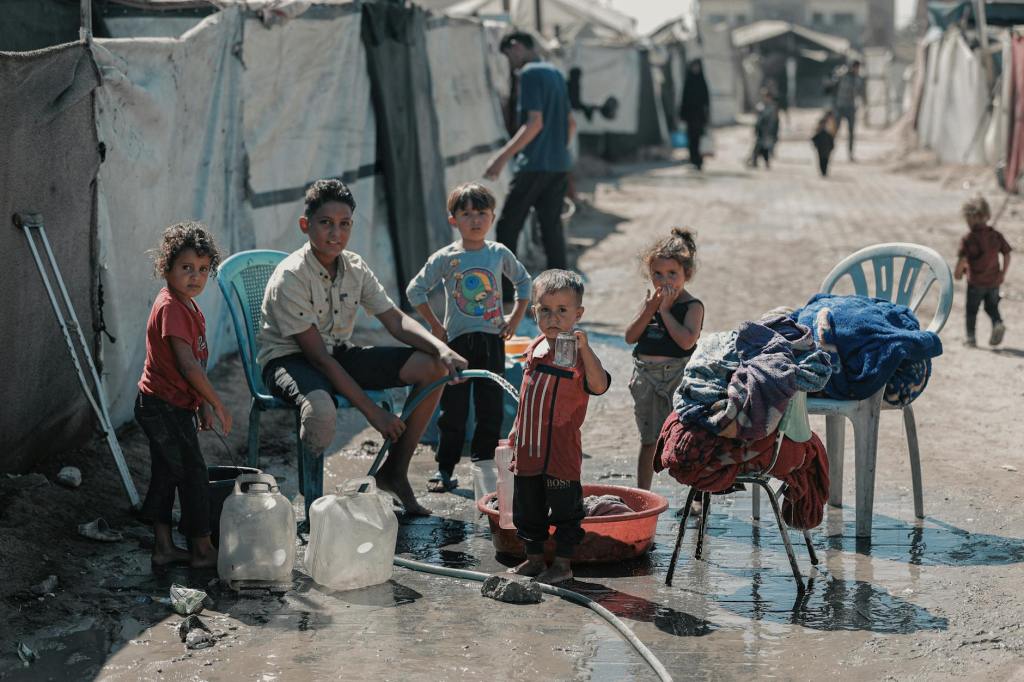
Sara al-Nemrat
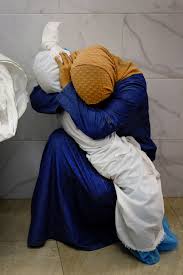
The winner of the 2024 World Press Photo of the Year was an image depicting a Palestinian woman cradling her niece wrapped in a white shroud, taken by Palestinian photojournalist Mohammed Salem. This is not a mere individual accolade, but indicative of the imprint that journalism emerging from Gaza has left on the global visual consciousness. Yet this image is, in many ways, a restrained representation of a broader body of work. Much of Gazan photojournalism confronts the viewer with scenes that precede the white shroud; moments in which the violence inflicted upon the body remains fully exposed. The insistence of those closest to the victim in life (closeness whether in familial relation or closeness because one is living under those same conditions of violence) to have the brutalised body photographed is something we have seen before. The mother of 14 year old Emmet Till, who was tortured and lynched, insisted on an open casket funeral so that the barbarity of what was done to him was on full display. This, it seems, is an instinct that arises when the damage is done, when the human being that was once a source of life is in an unrecognisable state of dismemberment and when all that is left is to share in the horror of it all. And it is this insistence on our bearing witness and the refusal to allow such violence to be sanitised or abstracted, that defines the work of Gazan journalists.
Israel’s refusal to allow Western ‘independent’ journalists into Gaza is often cited as a barrier to credible reporting on Gaza. The tendency to do so overlooks the extraordinary and indispensable work of Gazan journalists, and from this we can deduce whose journalism is deemed to have more credence. Rather than treating their reporting as a substitute born out of necessity, I argue that it should be understood as a form of documentation that the external journalist could never replicate.
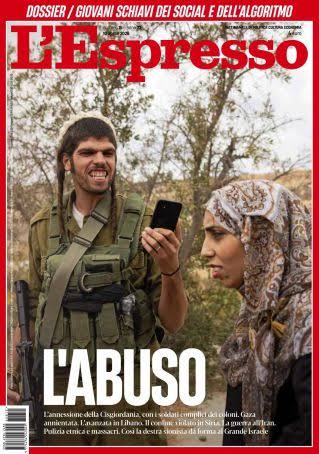
Their mode of journalism – primarily photography and videography – fortunately somewhat mitigates the distrust often directed in the West towards Palestinian journalists. As Virginia Woolf said, “Photographs are not an argument, simply a crude statement of fact addressed to the eye.” In this sense, the image can appear to bypass suspicion; it presents itself as immediate, unmediated, and therefore more difficult to dismiss outright. Though of course, the image’s credentials of objectivity do not always ensure immunity from suspicion and criticism if the reality depicted is an uncomfortable truth for some. This has been evident in recent controversies, such as the front-page photograph published by the Italian newspaper L’Espresso, depicting a settler grimacing at a Palestinian woman, which was absurdly criticised by some as an “antisemitic caricature”, despite the fact that a photograph by nature cannot be a caricature.
Having had the opportunity to hear directly from two Gazan journalists recently, I realised that the recurring and distinguishing quality of a Gazan journalist is that how they came to be documenters of genocide was purely an imposition of circumstance. Addressing the chamber at the Oxford Union, Motaz Azaiza reflected on the cruel twist of fate that meant the suffering of his people – and notably his documentation of it – was what facilitated the fulfilment of his lifelong dream to travel the world. He addressed the absurdity of the standing ovation he received upon entering the chamber, noting that it was a product of suffering and agony that he and his camera bore witness to. Similarly, I heard from 22-year-old Abu Bakr Abed, a sports broadcaster turned – in his own words – “war correspondent”.
Now, I’m not saying that a prerequisite for good journalism in a conflict zone is complete indifference to the profession, or that it should be some sort of accidental occupation that one wakes up one day and finds themself engaging in it out of necessity. However, this has created a form of journalism unlike any that we have seen before: one rooted in testimony rather than observation. The Gazan journalist is simultaneously a witness and, most likely, a future victim of the same crime they are documenting (their blue press jackets certainly increasing the likelihood of that). The Gazan journalist does not arrive at the scene in pursuit of an image; they are already implicated in it. Their camera is guided by an immediate ethical relationship to those they document.
This stands in contrast to the historical trajectory of war photography, particularly within Western media, where the imperative to capture and transmit violence has often existed alongside the risk of aestheticising it. The power of the image for the pursuit of justice has been undeniable, with the Vietnam War often credited as the first time war was brought into the living room of the average western citizen which certainly fueled the anti-war movement, but it also saw the emergence of the slogan “if it bleeds it leads”. From Vietnam onwards, war photography was a global enterprise and the photographer’s relation to the photographed scene of mutilated bodies mattered little. In much of traditional war photography, dignity is negotiated after the fact – in editing, publication choices and captions. For the Gazan journalist subject to those same conditions of violence that they are photographing, dignity is immediate and relational. Motaz Azaiza testified that the images we see on his Instagram are a mere fraction of the horror that he saw and chose not to photograph.
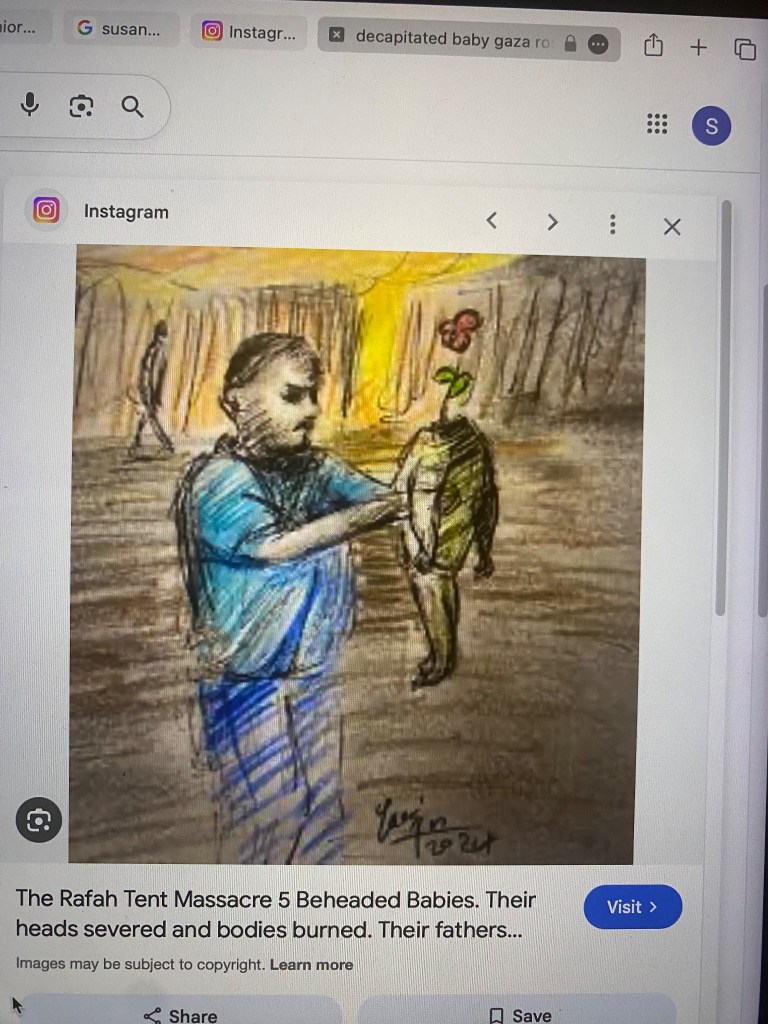
Though, for all its merits, we are barely capable of digesting their journalism. I often think of the image after the Rafah tent massacre of the man holding up a decapitated baby to the camera. The holding up of mutilated bodies before a camera, shaken violently, is by now a familiar gesture, as if to say, “don’t look away”. The photographer, however, will have no say in the life that the photograph will go on to live. Soon after this image was posted there emerged a drawing of the scene: the decapitated baby, still held up by the man, but this time with a rose growing out of the baby’s neck where the head should be. The sentiment of course clear, but this gross beautification of such a grotesque scene, was now made just digestible enough – it is this image that made its way onto Instagram stories, not its counterpart.
In a compelling piece of journalism, Quatre heures à Chatila (Four Hours in Shatila), Jean Genet recounts his experience of walking through Sabra and Shatila in the aftermath of the 1982 massacre. His insistence on the act of walking is crucial. As he writes, “A photograph has two dimensions, so does a television screen; neither can be walked through.” He dwells on the smells and microcosmic details that images we see fail to depict. “A photograph doesn’t show the flies nor the thick white smell of death. Neither does it show how you must jump over bodies as you walk along from one corpse to the next.” Yet his chosen medium, the written word, does not resolve this limitation. Even as he names what images omit, imagination cannot adequately reconstruct such extremity.
Genet also identifies that with the fixation of one’s vision upon the corpses, questions about what remains unseen inevitably arise. In contemporary journalism, we have seen headlines that wage war on syntax and grammar with the prevalent use of the passive voice rendering the active “killed” into the passive “found dead” (the four year old “found dead” is a “young lady” at that). The sight of the corpse makes the possibility of forgetting the active agent slim: “In the middle, near them, all these tortured victims, my mind can’t get rid of this “invisible vision”: what was the torturer like? Who was he? I see him and I don’t see him. He’s as large as life and the only shape he will ever have is the one formed by the stances, positions, and grotesque gestures of the dead fermenting in the sun under clouds of flies.”
In everything Abu Bakr Abed said, I sensed an underlying frustration with the limits of human empathy. He detailed the life of a ‘privileged’ Palestinian in Gaza; deprived of four walls, drinking from sewage and mourning ‘a few’ family members and friends. He made sure we knew how far removed we were from this situation and such is our inability to ever be able to fully digest it and empathise with it. He also made it clear that he would not wish this on anyone. But what does one do with that immense gap that remains– the one between us and them? If we gaze upon these images with the intention of closing that gap even slightly, then our gaze is a useless thing, done only in vain. This futility, of course, lies in our very human inability (and crucially lack of desire) to feel corporally and viscerally what they feel. The profound difference between the image and the reality it depicts only further renders our gaze futile.
Though, as the account of Jean Genet shows, this may not even be the failure of photography but a limitation inherent to perception itself. Even in direct physical proximity to corpses there remains a disjunction between experience and comprehension: “That city lying in smithereens which I saw or thought I saw, which I walked through, felt, and whose death stench I wore, had all that taken place?”
It is on this note that Susan Sontag ends her extended essay Regarding the Pain of Others, she theorises what it would be like to be the corpse we see in the images of war:
“These dead are supremely uninterested in the living: in those who took their lives; in witnesses – and in us. Why would they seek our gaze? What would they have to say to us? We – this ‘we’ is everyone who has never experienced anything like what they went through – don’t understand.
We don’t get it. We truly can’t imagine what it was like. We can’t imagine how dreadful, how terrifying war is; and how normal it becomes. Can’t understand, can’t imagine. That’s what every soldier, and every journalist and aid worker and independent observer who has put in time under fire, and had the luck to elude the death that struck down others nearby, stubbornly feels. And they are right.”
Though looking at these images is not entirely devoid of purpose, to do so is a profoundly selfish act, because bearing witness is the only way we may emerge on the other end with our humanity unscathed and intact. As Isabella Hammad puts it, in Recognizing the Stranger, our ignorance is the mutilation of the self: “We who are not there, witnessing from afar, in what ways are we mutilating ourselves when we disassociate to cope? To remain human at this juncture is to remain in agony.”. And as Muhammad El-Kurd puts it in Perfect Victims, in our disdain lies our humanity: “There are people who have contempt for the world that greets a nurse with her husband’s corpse on a stretcher, the world that forces a boy to carry his brother’s limbs in a bag. I am one of those people. And I am grateful for my disdain, for it is dignifying; it reminds me that I am human.”
A prerequisite for disdain? Eyes that remain fixated on the nurse and her murdered husband, and on the boy and what remains of his brother.
Bibliography:
- El-Kurd, Mohammed. 2025. Perfect Victims. Haymarket Books.
- Genet, Jean. 1983a. “Quatre Heures à Chatila.” Revue d’Études Palestiniennes N° 6 (1): 3–19.
- (Translation)“Four Hours in Shatila.” Journal of Palestine Studies 12 (3): 3–22. https://doi.org/10.1525/jps.1983.12.3.00p0453w.
- Hammad, Isabella. 2024. Recognising the Stranger. Fern Press.
- Sontag, Susan. 2003. Regarding the Pain of Others. Penguin Books.
- Woolf, Virginia. 1938. Three Guineas. New York: Harvest Books.


 The Oxford Arabist
Leave a comment